
SUSTAINABILITY
Materiality (Priority Issues)
Based on our basic sustainability policy, which states that “We will contribute to the achievement of a sustainable society through our business activities and enhance the prosperity of all stakeholders,” we have identified material issues for the realization of a better society and the growth of our Company, and have set related goals and KPIs.
Process for identifying material issues
|
STEP 01
Extraction of potential issues |
The secretariat of the Sustainability Committee, chaired by the President, lists potential general (broadly defined) social issues that may be relevant to the Company, based on various sustainability disclosure guidelines, evaluation items of ESG evaluation organizations, and SDGs. |
|---|---|
|
STEP 02
Materiality assessment and identification |
For each candidate item identified in Step 1, we conduct evaluations and mapping based on the concept of double materiality. Assessments are made along two dimensions: the Group’s exposure to the impacts of society and the environment (financial materiality), and the Group’s positive and negative impacts on stakeholders—including customers, shareholders and investors, suppliers, and local communities (impact materiality). 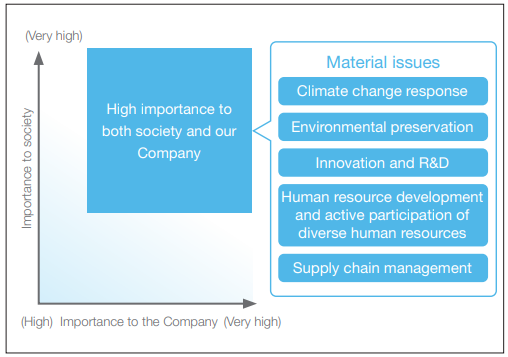 Basic issues that are prerequisites for business continuity
|
|
STEP 03
Setting goals and KPIs |
The Sustainability Committee and related departments examine and set goals and KPIs for each identified material issue. |
|
STEP 04
Deliberation and approval |
Goals and KPIs are approved after deliberation by the Sustainability Committee and reported to the Board of Directors |
Review of materiality
For material issues with established targets and KPIs, the Sustainability Committee reviews progress at least once a year and revises them as necessary.
Details of material issues
| Category | Issues and initiatives | FY2024 | From FY2025 onward |
Related SDGs |
|||
|---|---|---|---|---|---|---|---|
| Goals and KPIs | Results | Scope of goals and KPIs | Goals and KPIs | Scope of goals and KPIs | |||
|
Climate change response |
1.Reduction of greenhouse gas emissions
|
Reduction rate of greenhouse gas emissions (Scope 1 and 2; baseline: FY2021)
|
38% reduction |
Entire Group |
Reduction rate of greenhouse gas emissions (Scope 1 and 2; baseline: FY2021)
|
Entire Group |
|
|
2.Appropriate use of energy
|
Reduction of energy intensity
(baseline: FY2021)
|
9.0% decrease |
The Company and its domestic subsidiaries |
Reduction of energy intensity
(baseline: FY2021)
|
The Company and its domestic subsidiaries |
||
|
3.Contributing to reducing greenhouse gas emissions by customers through products
|
Contribution to reduction of greenhouse gases by expanding supply of high-performance antifoulings
(baseline: 2008)
* Data are for ocean-going vessels of 3,000 DWT or more |
1,530,000 t-CO₂ |
Entire Group |
Contribution to reduction of greenhouse gases by expanding supply of high-performance antifoulings
(baseline: 2008)
* Data are for ocean-going vessels of 3,000 DWT or more |
Entire Group |
||
| Environmental preservation(including water resources and biodiversity) |
1.Prevention of air and water pollution
|
Zero environmental incidents (yearly)
|
0 incidents |
The Company and its domestic subsidiaries |
Zero environmental incidents (yearly)
|
The Company and its domestic subsidiaries |
|
|
2.Waste management and recycling
|
Waste recycling rate
|
98% |
The Company and its domestic subsidiaries |
Waste recycling rate
|
The Company and its domestic subsidiaries |
||
|
3.Promoting the development of products with reduced environmental impact
|
Percentage reduction in use of environmental hormones, TX, etc.(*1)
(compared to FY2020)
(*1) Toluene, xylene, benzophenone, etc. (10 substances in total) |
-1.4%(*2) (1.4% increase) (*2) Notation revised from FY2024 |
The Company and its domestic subsidiaries |
Percentage reduction in use of environmental hormones, TX, etc.(*1) (compared to FY2020)
(*1) Toluene, xylene, benzophenone, etc. (10 substances in total) |
Entire Group |
||
|
4.Reduction of VOC emissions from products
|
Reduction of VOC emissions by expanding the supply of low-VOC coatings
(baseline: 2008)
*Data are for general anticorrosive coatings |
3,234t |
Entire Group |
Reduction of VOC emissions by expanding the supply of low-VOC coatings
(baseline: 2008)
*Data are for general anticorrosive coatings |
Entire Group |
||
|
5.Promotion of biodiversity conservation
|
Increase the sales ratio(*) of environmentally friendly high-performance antifoulings, which also contributes to measures against transboundary movement of marine organisms
(*) Percentage of total antifoulings (based on the number of vessels) |
50% |
Entire Group |
Increase the sales ratio(*) of environmentally friendly high-performance antifoulings, which also contributes to measures against transboundary movement of marine organisms
(*) Percentage of total antifoulings (based on the number of vessels) |
Entire Group |
||
|
Innovation and R&D |
1.Development of innovative products that contribute to global environmental protection
|
Ratio of environmental research themes, including the exploration of sustainable materials and their application to product design
|
72.8% |
Entire Group |
Ratio of environmental research themes, including the exploration of sustainable materials and their application to product design
|
Entire Group |
|
|
2.Development of intellectual property strategies and application to business
|
❶ Number of applications for patent rights related to newly developed technologies
(compared to FY2022)
|
❶ 54.5% increase |
Entire Group |
❶ Number of applications for patent rights related to newly developed technologies
(compared to FY2022)
|
Entire Group |
||
|
❷ Introduction of business analysis through the use of IP landscapes and promotion of its use in product development strategies
|
❷Ongoing |
❷ Introduction of business analysis through the use of IP landscapes and promotion of its use in product development strategies
|
|||||
|
3.Creation of new technologies through open innovation
|
Continue to promote development by collaborating with other companies, universities, and research institutions, exceeding the performance of the previous year, and by effectively utilizing external resources
|
About 5.5% decrease year on year |
Entire Group |
Continue to promote development by collaborating with other companies, universities, and research institutions, exceeding the performance of the previous year, and by effectively utilizing external resources
|
Entire Group |
||
|
Human resource development and active participation of diverse human resources |
1.Employee skill development
|
Rebuild the human resource development system from FY2024 to FY2026
|
Ongoing (e-learning introduced) |
The Company |
Rebuild the human resource development system from FY2024 to FY2026
|
The Company |
|
|
2.Improving employee job satisfaction
|
Sustainably improving employee engagement
|
Score improvement achieved |
The Company |
Sustainably improving employee engagement
|
The Company |
||
|
3.Promotion of the active participation of women
|
❶ Percentage of female employees among new or mid-career hires
|
❶33% |
The Company |
❶ Percentage of female employees among new or mid-career hires
|
The Company |
||
|
❷ Rate of taking child-care leave
|
❷100% |
❷ Rate of taking child-care leave
|
|||||
|
Supply chain management |
1.Supplier management through CSR assessment(*)
|
Supplier evaluation rate based on the UN Global Compact Self-Assessment Questionnaire (SAQ)
|
98.0% |
The Company |
Supplier evaluation rate based on ESG questionnaires (centrally managed through a cloud-based system)
|
Entire Group |
|
|
2.Promotion of green procurement
|
Percentage of suppliers certified under ISO 14001
|
62.6% |
The Company |
Percentage of suppliers certified under ISO 14001
|
Entire Group |
||




During FY2024, as the scope of activities expanded globally, a more specialized approach became necessary. Accordingly, the system for supplier surveys and management was transitioned to ESG questionnaires managed via a cloud-based platform. In line with this transition, from FY2025 the wording of the materiality target has been revised from “Supplier management through CSR assessment” to “Establishment of a supplier management system.”