
IR
About Coatings
Coatings are applied to many things around us—buildings, automobiles, ships, bridges, containers, and furniture, to name a few—and these coatings support social infrastructure and industrial activity by protecting, beautifying, and adding special functionality to surfaces. On this page, we explain in clear terms the roles of coatings, the characteristics of the industry, its basic components, and the fundamentals of the coating process.
What Are Coatings?
Coatings protect, beautify, and add special functionality when applied to the surface of objects. They are used in a wide variety of settings around us, ranging from building exteriors, automobiles, and ships to large structures such as bridges and tanks, as well as containers, furniture, and daily necessities.
By protecting materials from corrosion and deterioration and enhancing safety and durability, coatings support the foundations of society. In fact, modern society could not function without coatings, which fulfill a vital behind-the-scenes role, supporting society at large.

Four Characteristics of the Coatings Business
Extremely broad range of applications
Coatings are applied to the surfaces of many different materials, including steel, concrete, and plastics. Their applications are highly diverse, and required performance varies greatly depending on the environment in which they are used—for example, performance requirements include preventing rust, mitigating staining, forestalling the attachment of marine organisms, reducing friction, and adding color and gloss. As a result, many products are engineered specifically for each application. Even when two coatings look similar, their formulations can be entirely different depending on their intended use and application environment.

Environmental and safety considerations are essential
In the past, many substances harmful to human health and the environment were widely used in coatings. Today, the industry is shifting to lead‑ and chromium‑free products, reducing volatile organic compounds (VOCs), and developing waterborne coatings to lower environmental impact. In the field of antifouling coatings, development also focuses on reducing seawater friction and inhibiting the attachment of marine organisms to improve fuel efficiency and cut greenhouse gas emissions. Coatings have evolved from mere surface materials into technologies that contribute to improved environmental performance and safety.

Many active manufacturers in the industry
The coatings industry includes major manufacturers who cover a broad range of fields but also contains other manufacturers specializing in specific applications or fields. This diversity reflects the industry’s characteristics; performance requirements and technical specifications vary greatly by application, and some segments are relatively accessible for new entrants. As a result, companies with strengths in areas such as automobiles, ships, or construction each play active roles in their own fields.

Coatings function as semi‑finished products
A coating is not fully functional at the point of shipment. It only delivers its intended performance after being applied to a material and subsequently dried and cured to form a coating film. In this sense, coatings are both finished products and semi‑finished products that are eventually completed through the final application step. Therefore, process management—including not only product quality but also on‑site application conditions, the coating process itself, and final inspection of the finish—is critical.

What Are Coatings Made Of?
Coatings primarily consist of the following four components.
Resin (varnish)
Resin forms the “skeleton” of a coating and plays a central role in determining the performance of the coating film formed after drying. Many final properties—durability, adhesion, weather resistance—are governed by the resin’s characteristics. Resin types include acrylics, epoxies, polyurethanes, silicones, and fluoropolymers, each with distinct properties. The appropriate resin is selected according to the intended use and required performance.
Pigments
Pigments are powdered components that give coatings color and functionality. Aside from color pigments that provide color, extender pigments deliver thickness and strength to the coating film, while functional pigments add properties such as rust prevention. Pigments are responsible for more than color; they are important elements that affect the performance of the coating film itself.
Additives
Additives are blended into coatings to improve ease of application and enhance the performance of the dried coating film. Although used in small quantities, they significantly affect finish and durability and therefore play an important role in coating formulation.
Solvents
Solvents adjust the viscosity of a coating and make it easier to apply; they evaporate during drying and do not remain in the final coating film. In recent years, the industry has seen advancement in efforts to reduce environmental impact, including the development of waterborne and high‑solid formulations (reducing solvent content while increasing solids).
Coating Film Structure
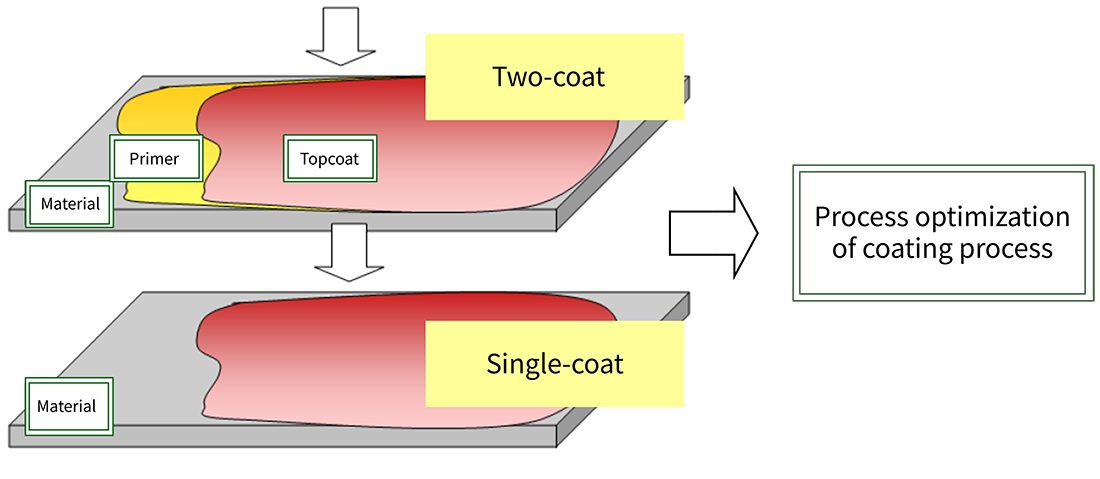
A coating film is typically designed as a three‑layer structure consisting of primer, intermediate coat, and topcoat. By assigning distinct roles to each layer, the system as a whole delivers protective performance, enhances appearance, and adds functionality. Meanwhile, coatings integrating multiple functions into a single product have been developed to improve application efficiency.
| Topcoat |
|
|---|---|
| Intermediate coat |
|
| Primer |
|
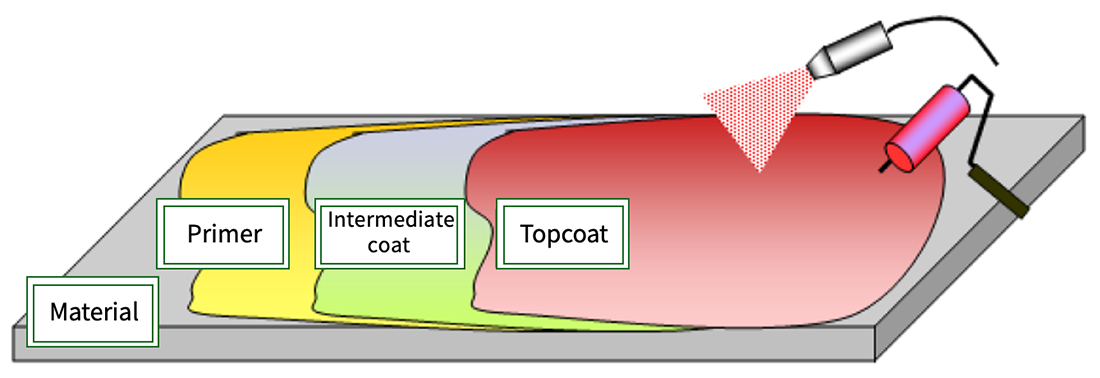
For the sake of process optimization, single‑coat or two‑coat systems are sometimes adopted.
Flow of Coating Process
The coating process consists of more than simple application; it includes preparing the substrate and following prescribed steps to form a coating film with the intended performance.
Surface preparation
Before coating, rust and contaminants are removed, and an appropriate surface profile with suitable roughness is created. Processes such as blasting increase adhesion and are critical pretreatment steps that strongly influence coating performance.
Coating application
Depending on the intended use and required performance, multiple coatings are applied in sequence. Each layer performs a specific role, and together they form the final functional film.
Film inspection
After application, appearance and film thickness are checked against specifications. Film thickness, which is an essential quality control parameter, is measured using special instruments.
Discover More About CMP


