
SUSTAINABILITY
Response to Climate Change
Basic concept
The effects of climate change are becoming more serious year by year, with significant impacts on the natural environment and society, and we recognize that climate change is an important issue for us as well. As extreme weather events occur around the world, efforts to transition to a decarbonized society are accelerating around the world. The Paris Agreement has set a common goal to limit the rise in global average temperature to well below 2°C compared to pre-industrial levels, and to pursue efforts to limit it to 1.5°C.
In April 2024, the CMP Group announced its Carbon Neutrality Declaration, aiming to reduce total greenhouse gas (GHG) emissions by 45% by fiscal 2030 (compared to fiscal 2021) and achieve carbon neutrality by fiscal 2050.
In addition to reducing GHG emissions from our own activities, we believe it is important to contribute to society-wide GHG emission reductions through the products we provide.
We will also promote the reduction of GHG emissions as a measure to mitigate the progress of climate change. We are committed to reducing GHG emissions throughout our production and supply chain processes. This includes achieving “low-carbon production” through measures such as reducing energy consumption in production, utilizing renewable energy sources, and transitioning to low-carbon raw materials, “GHG emission reduction through products with environmental contribution value,” such as low-friction antifoulings and biomass coatings, and “GHG emission reduction through the supply chain” by implementing strategies such as the reuse of product containers.
We will work to realize a society resilient to climate change risks as a measure to adapt to environmental changes caused by climate change. Global warming associated with climate change is expected to have significant impacts on people’s lives and health.
We aim to realize a society that can adapt to environmental changes due to climate change through the expansion of products that have quality of life (QOL) improvement value, such as suppressing indoor temperature rises with heat-shielding coatings that have high solar reflectivity. Reduction of GHG emissions is considered important as a climate change mitigation measure, and transparent disclosure of climate-related information is required.
We support the Task Force on Climate-related Financial Disclosures (TCFD) and disclose information on the financial impact of climate-related risks and opportunities based on the TCFD framework.
Management structure
The Sustainability Committee’s Climate Change Subcommittee and related departments are working together to reduce GHG emissions and save energy. At our overseas Group companies, we are proactively working in compliance with the laws and regulations of each country.
We receive monthly reports on energy usage from domestic Group companies and once a year from overseas Group companies.
Goals and KPIs
| Issues and initiatives | FY2024 | From FY2025 onward | Scope | |
|---|---|---|---|---|
| Goals and KPIs | Results | Goals and KPIs | ||
| Reduction rate of greenhouse gas emissions (Scope 1 and 2; baseline: FY2021) |
|
38% reduction |
|
Entire Group |
| Reduction of energy intensity(baseline: FY2021) |
|
9.0% decrease |
|
The Company and its domestic subsidiaries |
| Contribution to reduction of greenhouse gases by expanding supply of highperformance antifoulings (baseline: 2008) |
|
1,530,000 t-CO2* |
|
Entire Group |
Data are for ocean-going vessels of 3,000 DWT or more
Initiatives and track record
Greenhouse gas emissions
Scope 1 and 2 emissions
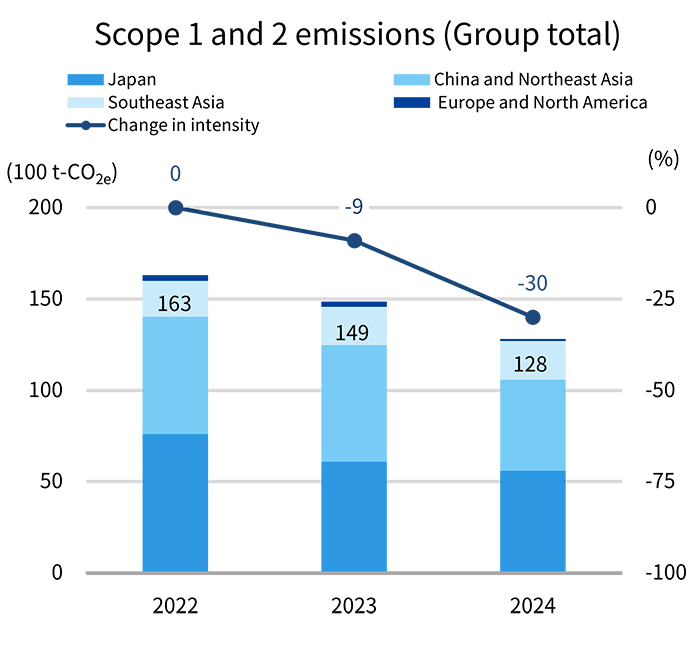
The total CO2 emissions (Scope 1 and 2) of the CMP Group amounted to 12,809 tons, a decrease of 2,064 tons from the previous fiscal year.
The CO2 emissions intensity in fiscal 2024 decreased by 30% compared with fiscal 2022, showing an improvement over the 9% reduction recorded in fiscal 2023. Contributing factors included the switch to 100% renewable electricity for purchased power at the Group’s site in the Netherlands and the expanded procurement of renewable electricity by Group companies in Japan.
| Unit | 2022 | 2023 | 2024 | ||
|---|---|---|---|---|---|
| Production sites | CO2 emissions | t-CO2e | 14,569 | 13,428 | 11,452 |
| CO2 emission intensity | kg-CO2e/t | 75 | 70 | 54 | |
| Non-production sites | CO2 emissions | t-CO2e | 1,733 | 1,445 | 1,357 |
| CO2 emission intensity | kg-CO2e/m2 | 110 | 71 | 64 |
Scope 1 emissions
The CMP Group’s total Scope 1 emissions decreased by 264 tons compared with fiscal 2023, representing a 6% reduction from fiscal 2023 and a 5% reduction from fiscal 2022.
Scope 1 emissions
(Unit: t-CO2e)
| 2022 | 2023 | 2024 | ||
|---|---|---|---|---|
| CO2(energy source) | 4,168 | 4,205 | 3,941 | |
| CO2 (energy source) |
Japan | 3,006 | 2,840 | 2,976 |
| China and Northeast Asia | 1,058 | 1,240 | 813 | |
| Southeast Asia | 91 | 111 | 136 | |
| Europe and North America | 13 | 14 | 16 | |
| CO2 (non-energy source) | 0 | 0 | 0 | |
| N2O | 0 | 0 | 0 | |
| HFCs | 0 | 0 | 0 | |
| CH4 | 0 | 0 | 0 | |
| SF6 | 0 | 0 | 0 | |
| NF3 | 0 | 0 | 0 | |
Scope 1 follows the GHG Protocol definition.
Scope 1: Direct GHG emissions that occur from sources that are controlled or owned by an organization
To calculate Scope 1 emissions, we used emission factors in accordance with the Act on Promotion of Global Warming Countermeasures.
Scope 2 emissions
The CMP Group’s total Scope 2 emissions decreased by 1,800 tons compared with fiscal 2023, representing a 17% reduction from fiscal 2023 and a 27% reduction from fiscal 2022.
Scope 2 emissions
| Unit | 2022 | 2023 | 2024 | |
|---|---|---|---|---|
| Total emissions | t-CO2e | 12,134 | 10,668 | 8,868 |
| Japan | t-CO2e | 4,601 | 3,244 | 2,611 |
| China and Northeast Asia | t-CO2e | 5,360 | 5,146 | 4,175 |
| Southeast Asia | t-CO2e | 1,885 | 1,981 | 1,986 |
| Europe and North America | t-CO2e | 288 | 297 | 96 |
Scope 2 follows the GHG Protocol definition.
Scope 2: Indirect GHG emissions associated with the purchase of electricity, steam, heat, or cooling
To calculate Scope 2 emissions from our domestic bases, we used adjusted emission factors based on those provided by each electric utility in accordance with the Act on Promotion of Global Warming Countermeasures.
For overseas bases, emission factors were based on each country’s laws and regulations or on the IEA Emissions Factors.
Scope 3 emissions
The CMP Group’s total Scope 3 emissions
(Unit: t-CO2e)
| 2022 | 2023 | 2024 | |
|---|---|---|---|
| 1. Goods and services purchased | 570,921 | 734,560 | 883,650 |
| 2. Capital goods | 2,562 | 3,664 | 4,016 |
| 3. Fuel- and energy-related activities (not included in scope 1 or scope 2) |
2,348 | 2,350 | 2,339 |
| 4. Transportation and distribution (upstream) | 9,195 | 8,496 | 7,952 |
| 5. Waste generated in operations | 3,845 | 3,162 | 3,672 |
| 6. Business travels | 318 | 424 | 557 |
| 7. Employee commuting | 2,145 | 3,163 | 2,904 |
| 8. Leased assets (upstream) | 0 | 0 | 0 |
| 9. Transportation and distribution (downstream) | 0 | 0 | 0 |
| 10. Processing of products sold | 5,926 | 6,108 | 6,809 |
| 11. Use of products sold | 0 | 0 | 0 |
| 12. End-of-life treatment of products sold | 635 | 690 | 774 |
| 13. Leased assets (downstream) | 0 | 0 | 0 |
| 14. Franchises | 0 | 0 | 0 |
| 15. Investments | 0 | 0 | 0 |
| Total | 597,894 | 762,617 | 912,673 |
Calculated based on GHG Protocol standards. For the calculations, we used the emission intensity described in IDEAv2 (Emission Intensity Database for Calculating Greenhouse Gas Emissions and Other Emissions of an Organization Through Its Supply Chain [Ver. 3.2]). For transportation, the calculations were made in accordance with the Ministry of Economy, Trade and Industry’s notification on the method for calculating energy consumption for transportation of freight cargoes by freight forwarders.
Composition of Scope 1, 2, and 3 emissions
The CMP Group total produced 925,000 tons of Scope 1, 2, and 3 emissions, 96% of which were from purchased raw materials (Scope 3) and 1% from Scope 1 and 2 emissions.

Energy saving (factories and offices)
Trends in energy consumption
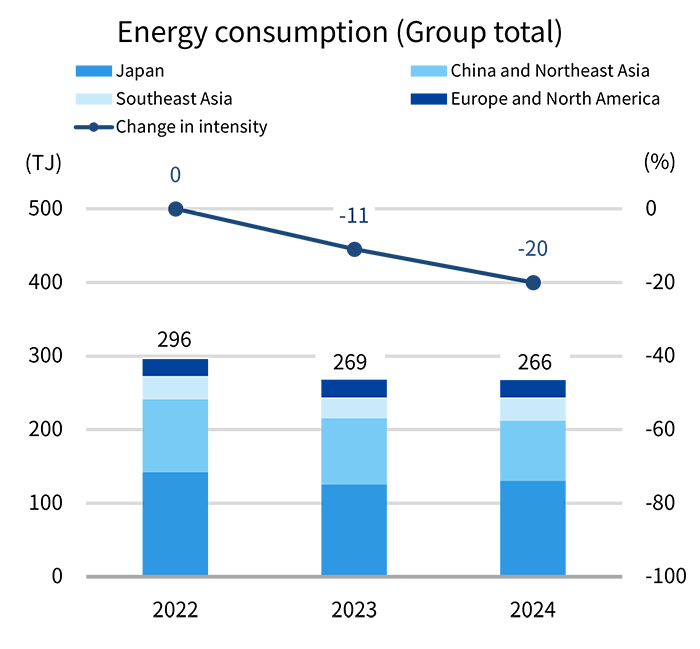
The CMP Group’s total energy consumption in fiscal 2024 was 266 TJ, down 3 TJ from the previous fiscal year. The energy intensity improved by 20% compared with fiscal 2022.
Contributing factors included replacing dispersers, compressors, and air conditioners, installing LED lighting, and implementing strict power demand management at factories and laboratories in Japan.
| Unit | 2022 | 2023 | 2024 | ||
|---|---|---|---|---|---|
| Production sites | Energy consumption | TJ | 262 | 236 | 231 |
| Energy intensity | GJ/t | 1.3 | 1.2 | 1.1 | |
| Non-production sites | Energy consumption | TJ | 33 | 33 | 35 |
| Energy intensity | GJ/m² | 2.1 | 1.6 | 1.7 |
Purchase of electricity and other energy sources
The CMP Group is promoting a switch to the purchase of renewable electricity. In 2024, the amount of renewable electricity purchased was 28% of the total purchased electricity. The Group has also installed solar power generation for its own consumption. In 2024, the total electricity produced by our solar power generation systems amounted to 352 MWh.
Amount of electricity, heat, and other energy sources purchased
| Unit | 2022 | 2023 | 2024 | |
|---|---|---|---|---|
| Electricity | TJ | 227 | 201 | 203 |
| Heat | TJ | 1 | 1 | 1 |
| Steam | TJ | 0 | 0 | 0 |
| Cooling | TJ | 0 | 0 | 0 |
Amount of renewable electricity purchased
| Unit | 2022 | 2023 | 2024 | |
|---|---|---|---|---|
| Purchased electricity | TJ | 12 | 41 | 56 |
| Percentage of total purchased electricity | % | 5 | 21 | 28 |
Amount of electricity produced by solar power generation
| Unit | 2022 | 2023 | 2024 | |
|---|---|---|---|---|
| Hiroshima Head Office | MWh | 10 | 11 | 11 |
| CHUGOKU PAINTS B.V. | MWh | 281 | 129 | 121 |
| TOA-CHUGOKU PAINTS CO.,LTD. | MWh | - | - | 220 |
Fuel consumption
The CMP Group is actively upgrading outdated equipment to reduce fuel consumption. The Group is also working to enhance facility efficiency by improving boiler performance and reducing operating hours.
Consumption by fuel type
| Unit | 2022 | 2023 | 2024 | |
|---|---|---|---|---|
| Natural gas | TJ | 20 | 21 | 15 |
| Class A heavy oil | TJ | 38 | 36 | 38 |
| Light oil | TJ | 2 | 3 | 0 |
| Kerosene | TJ | 2 | 2 | 2 |
| Others | TJ | 4 | 4 | 6 |
Energy saving (transportation)
Energy consumption during transportation
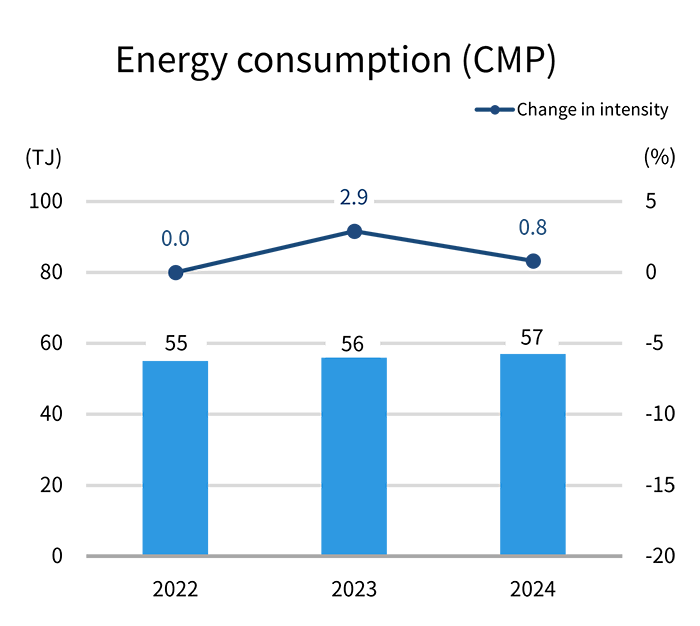
The total energy consumption during transportation by CMP (parent company basis) in fiscal 2024 was 57 TJ, a 2% increase from fiscal 2023. The energy intensity (per unit of transportation volume) rose by 0.8% compared with fiscal 2022, but this represented an improvement over the 2.9% increase recorded in fiscal 2023.
CO2 emissions during transportation
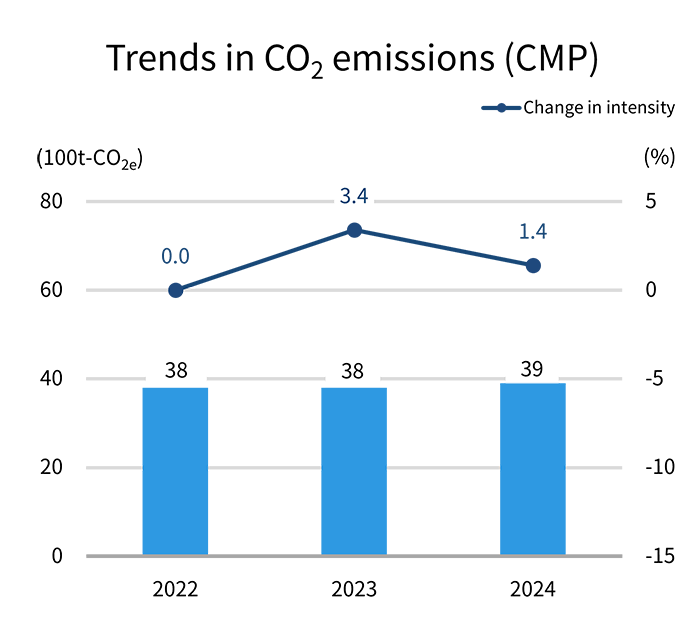
CMP’s CO2 emissions during transportation in fiscal 2024 increased slightly from fiscal 2023 to 3,900 tons. The CO2 emissions intensity (per unit of transportation volume) rose by 1.4% compared with fiscal 2022, but this represented an improvement over the 3.4% increase recorded in fiscal 2023.
Improving transportation efficiency
We are continuously working on increasing the load capacity and the size of vehicles for mainline transportation to expand the amount of cargo transported at one time.
Shift to transportation means with less environmental impact
We continue to implement modal shifts from truck transportation to railways, ships, and other forms of transport that emit less CO2.
Shortening transportation distance
We propose the shortest transportation routes to freight forwarders and review them continuously.
Compliance with the Act on Rational Use and Proper Management of Fluorocarbons
Management of fluorocarbons
Owners of commercial refrigeration and air conditioning equipment that use fluorocarbons are required to thoroughly manage the fluorocarbons they use and to report the leakage of fluorocarbons in excess of a certain amount. Our Group companies in Japan own 414 units of such equipment and work to properly monitor the amount of fluorocarbons leaked in accordance with the management criteria established by the government. In fiscal 2024,
there were no leaks of fluorocarbons of 1,000 tons of CO2 or more.
Stakeholder engagement
Indirect engagement through the Japan Paint Manufacturers Association
CMP is a member of the Japan Paint Manufacturers Association (JPMA), which, as a corporate regular member of the Japan Chemical Industry Association (JCIA), carries out its activities in line with the JCIA’s policies.
The JCIA has formulated a long-term strategy aimed at providing solutions to global warming and achieving a sustainable society toward and beyond 2050, defining the chemical industry’s vision for the future and the pathways to realize it.
Following this policy, the JPMA also promotes related initiatives. Coatings support the generation of green electricity through anticorrosive coatings for offshore wind turbines and silicone coatings for solar panels. Furthermore, coatings for electric wires and cables contribute to the transmission and storage of electricity in decentralized renewable energy systems. Through its participation in the JPMA, CMP is therefore indirectly engaged in initiatives to address climate change.
Participation in the VOC Working Group of the Japan Paint Manufacturers Association
The Japan Paint Manufacturers Association (JPMA) is working to reduce indirect CO2 emissions by reducing non-methane volatile organic compounds (NMVOCs). Every year, JPMA calculates the actual status of VOC emissions from coatings based on information from its member companies. We are also working to reduce indirect CO2 emissions by reducing VOCs.