
SUSTAINABILITY
Supply Chain Management
Table of Contents
Basic concept
While carrying out material procurement to fulfill our responsibility to supply our customers, we will pursue transactions that take into account social issues, including laws and regulations, the environment, human rights, and conflicts, and contribute to the realization of a sustainable society together with our business partners. We have revised our existing Purchasing Policy and established a Procurement Policy. The CMP Group is enhancing sustainability awareness with a wide range of business partners in Japan and overseas and promoting activities throughout the supply chain.
Management structure
The Supply Chain Subcommittee of the Sustainability Committee receives monthly, quarterly, and annual reports on the material procurement status of the CMP Group in Japan and overseas. Under a system in which the Supply Chain Subcommittee collectively manages and guides the CMP Group’s supply chain, we pursue responsible procurement activities in accordance with our Procurement Policy. We will further strengthen our procurement management system to realize sustainability throughout the supply chain such as by checking the status of CSR activities and ISO 14001 certification of our business partners.
Goals and KPIs
| Issues and initiatives | FY2024 (Scope:The Company) | From FY2025 onward (Scope:Entire Group) | |
|---|---|---|---|
| Goals and KPIs | Results | Goals and KPIs | |
| Supplier management through CSR assessment |
Supplier evaluation rate based on the UN Global Compact SelfAssessment Questionnaire (SAQ) |
98.0% |
Supplier evaluation rate based on ESG questionnaires (centrally managed through a cloud-based system) |
| Promotion of green procurement |
Percentage of suppliers certified under ISO 14001 |
62.6% |
Percentage of suppliers certified under ISO 14001 |
During FY2024, as the scope of activities expanded globally, a more specialized approach became necessary. Accordingly, the system for supplier surveys and management was transitioned to ESG questionnaires managed via a cloud-based platform. In line with this transition, from FY2025 the wording of the materiality target has been revised from “Supplier management through CSR assessment” to “Establishment of a supplier management system.”
Initiatives and track record
■ Sustainable procurement strategy for co-creating a sustainable future
To build a sustainable future, CMP actively promotes procurement activities that create social value across the entire supply chain in line with its Procurement Policy, which is grounded in the Basic Sustainability Policy. When selecting suppliers, we conduct rigorous and strategic evaluations from three perspectives:
1. Supplier surveys to assess corporate information, and quality and supply systems
2. Evaluation of environmental, social, and governance (ESG) initiatives through ESG questionnaires
3. Verification of international management system certifications such as ISO 9001 and ISO 14001
Based on these criteria, CMP evaluates suppliers and asks them to confirm their understanding of the Procurement Policy at the time of contract. We place importance on relationships with partners who share our vision of co-creating a sustainable future and work to build a supply chain founded on trust and co-creation. Members of the Supply Chain Subcommittee are assigned not only at headquarters but also across all manufacturing and procurement sites. By establishing a framework that facilitates regular dialogue with suppliers on ESG-related topics, we aim to ensure consistency and advance responsible procurement throughout the Group.
■ Supplier assessment
Survey of suppliers’ green procurement (CMP)
In order to confirm the environmental initiatives of suppliers from whom CMP has already purchased a certain amount, we survey their ISO 14001 certification status and other relevant information. For suppliers that have not yet obtained relevant certifications, we encourage them to do so and support their efforts to reduce environmental impact.

Survey results on ISO 14001 certification acquisition status
ESG questionnaires
The implementation rate of supplier evaluations conducted using the UN Global Compact SAQ reached 96.1% in fiscal 2023, significantly exceeding the fiscal 2024 target of 75%.
Accordingly, from mid-fiscal 2024, we began expanding these activities globally and transitioned to conducting ESG questionnaires for suppliers via an external cloud-based platform. The questionnaire items include, in addition to basic information, assessments of environmental initiatives—covering environmental policies and greenhouse gas emission calculations; social initiatives—covering employee health and safety and human rights; governance—covering fair corporate practices and information security; and supply chain management—covering legal compliance and conflict minerals. While the target response rate was set at 60–70%, in fiscal 2024 we received responses from 428 of the 600 suppliers surveyed, achieving a response rate of 71%.
We will continue to conduct this survey annually. When concerns are identified through the evaluation results, we share our policies with the relevant suppliers and work collaboratively to promote initiatives that mitigate supply chain risks and strengthen business operations.
Survey results for FY2024
A total of 428 companies responded to the questionnaire.
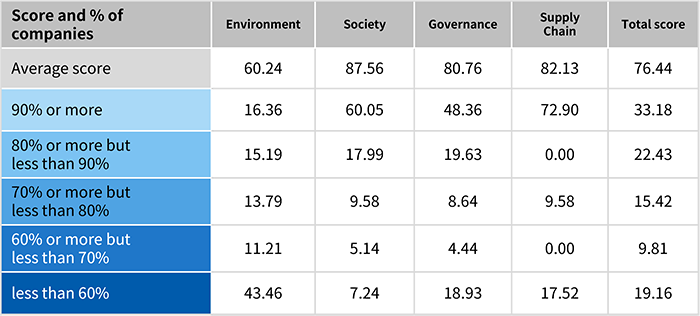
Status by item
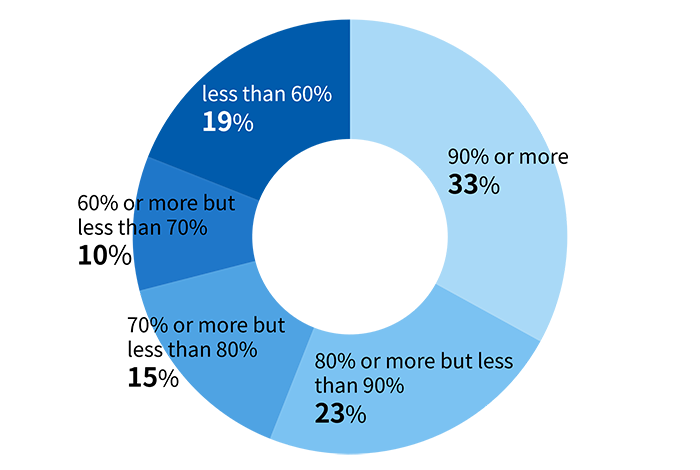
Distribution of suppliers by score
■ Response to suppliers with identified issues
In fiscal 2024, we took the following actions for suppliers identified as having issues through the ESG questionnaire.
- Based on the evaluation results of the ESG questionnaire, we distributed a summary of the sustainability questionnaire findings to our business partners to help them reaffirm the importance of ESG initiatives and conduct objective self-assessments.
- For items requiring improvement identified through the ESG questionnaire, we asked suppliers to establish improvement plans and developed a framework to monitor their progress.
- As part of our supplier management efforts, we also conducted on-site inspections and held discussions based on both ESG questionnaire results and internal objective evaluations to confirm issues and agree on improvement measures. In fiscal 2024, on-site inspections were carried out at a total of 10 suppliers.
Inspection results for five key suppliers
| Supplier | Purpose of inspection | Inspection results and CMP’s response |
|---|---|---|
| A | We conducted the inspection due to concerns regarding business downsizing and the stability of supply. The items that had been rated relatively low in the 2023 CSR assessment—supply chain, labor, and human rights—showed significant improvement in the 2024 ESG evaluation, and we confirmed the supplier’s ongoing efforts in these areas. |
As the supplier’s manufacturing facilities were aging and the shipping bases and inventory locations were limited, there were concerns that supply could be disrupted in the event of damage caused by natural disasters. However, we confirmed that the supplier had implemented appropriate countermeasures. We also confirmed that the supplier had established a sustainability promotion committee and other relevant bodies, and was promoting CSR-related initiatives. |
| B | We conducted the inspection as a countermeasure following the occurrence of an information security incident. | The internal system for protecting against external cyberattacks was in place; however, both CMP and the supplier recognized that addressing issues such as erroneous transmissions from within the company to external parties requires employees’ individual awareness and skills, and that continuous internal training is necessary. We encouraged the supplier to issue renewed internal reminders and confirmed its future training plans. |
| C | We conducted the inspection because the supplier’s corporate governance, human rights, and supply chain management had received low evaluations in the 2023 CSR assessment. | The CSR promotion framework and the basic approach to supply chain management had been established to some extent. We found no issues with the production or supply systems. By transferring part of production to overseas facilities, production capacity had doubled, and we confirmed that a stable supply system was in place. The supplier was also found to be conducting its operations with a sufficient understanding of human rights issues in overseas locations. |
| D | This major overseas supplier received a high CSR assessment score of 99%. We conducted the inspection due to concerns regarding potential supply instability under tight market conditions, a high employee turnover rate, information security risks, and incidents of product misdelivery. |
We found no issues with production capacity or supply, as production had been expanded. Although the supplier, being a large enterprise, is subject to external cyberattacks, it has established a robust cybersecurity system. We provided guidance using an example of a labeling error that could potentially lead to a serious accident. As the supplier’s turnover rate was high and the ratio of female employees was low, we will continue to monitor improvements through ongoing efforts to raise awareness of working conditions and human rights. |
| E | We conducted the inspection of this major overseas supplier to determine whether to continue business with it following a fire accident that resulted in the suspension of its production and supply, which in turn affected CMP’s own product manufacturing and supply. | The supplier received approval from the authorities to resume production and supply in just under a month after the fire. The supplier explained that operations were permitted to restart after the authorities confirmed the cause of the fire and assessed that the corrective measures implemented were sufficient. The post-recovery measures were found to be adequate, and as the company is a key supplier with broad influence across the industry, we decided to resume business transactions. |